14th July 2026
How refrigeration is the true hero of major sporting tournaments – on and off the pitch

7 Years parts & labour warranty


Brand and Marketing Manager EMEA
Europe’s summers are getting hotter – and the consequences for commercial refrigeration are becoming harder to ignore.
The Copernicus Climate Change Service confirmed that June 2025 was the warmest June on record for western Europe, with temperatures 2.81°C above the 1991-2020 average.
National temperature records were broken across Portugal, Spain and England, with parts of southern Europe exceeding 46°C.
In 2026, the pattern has intensified. France recorded its hottest day since 1947, with 44.3°C at Pissos on June 23.
Spain and Portugal pushed toward 45°C and beyond 42°C respectively, while heat-stressed power grids led to blackouts in Turin, in Italy. In the UK, temperatures exceeded 35°C in May, June and July for the first time on record – triggering widespread refrigeration failures across major retailers that left chilled aisles closed and stock withdrawn from sale.
For retail and convenience operators, the implication is clear: the equipment that was specified for a cooler climate is now operating in conditions it was never designed for.
When refrigeration fails during a heatwave, the impact is immediate.
Chilled and frozen stock must be withdrawn from sale, while high-value fresh lines – meat, dairy, prepared meals and sandwich ranges, for example – are among the most exposed.
Across the EU, Regulation (EC) No. 852/2004 on the hygiene of foodstuffs requires food businesses to maintain the cold chain at all stages of storage and distribution.
If safe temperatures cannot be maintained, the safest course of action is to remove stock from sale entirely.
The financial consequences extend beyond wasted product – a refrigeration failure during peak trade costs operators in lost revenue, emergency call-out fees and, in some cases, enforcement action.
Across the wider supply chain, cold-chain failures contribute to significant levels of food waste and generate a cost that is both financial and reputational.
Grocery Gazette has described refrigeration failures as “grocery’s next climate pressure point” – a structural challenge for the sector rather than an isolated incident.
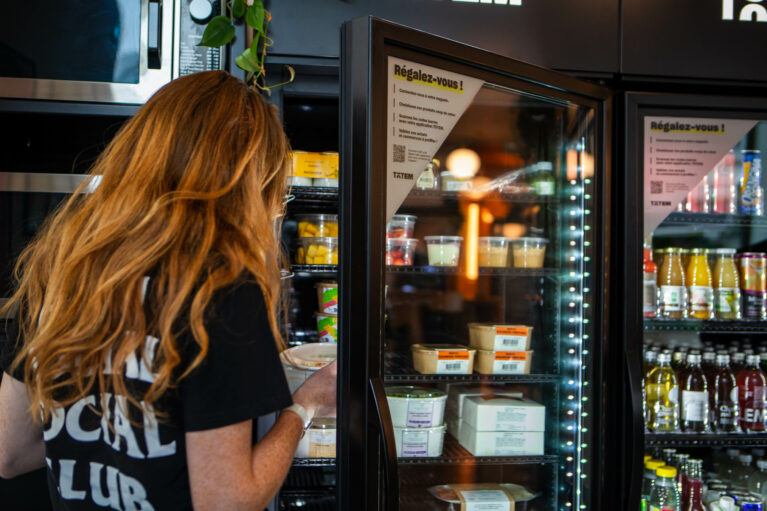
The good news is that much of this risk is manageable through preparation. Here are some measures worth considering:
Routine servicing – cleaning condenser coils, checking door seals, verifying refrigerant levels – should be completed before the warm months arrive.
Equipment that is serviced proactively outperforms equipment serviced only when it breaks.
Regular checks throughout the day, including recovery times after door openings and overnight holding temperatures, help operators catch temperature drift before it becomes a compliance issue.
Digital monitoring combined with manual checks provides the strongest protection.
Units placed in direct sunlight, near heat-generating equipment or in poorly ventilated areas will work harder and fail sooner.
Ensuring adequate clearance around condenser vents and keeping surrounding areas clean reduces strain on the system.
Commercial refrigeration is rated to perform within a specified ambient temperature range.
If your store or site regularly experiences high ambient temperatures during summer, it is worth reviewing whether your current equipment is specified for those conditions.
Overloaded cabinets restrict airflow and reduce cooling efficiency.
Keeping stock levels sensible, particularly during warm spells, protects both product quality and equipment performance.
When ambient temperatures rise, refrigeration systems work harder – and energy consumption increases with them. Over a sustained warm spell, this can add meaningfully to operating costs.
True’s energy cost calculator can help operators estimate the lifetime savings that could be achieved by choosing energy-efficient equipment, compared to what is currently in their estate.
Not all commercial refrigeration is built for the same conditions.
Many of the refrigeration failures reported during recent heatwaves have occurred because standard units were operating beyond their designed ambient range.
Often, larger supermarket chains rely on remote, centralised refrigeration systems – where a single external compressor unit controls whole banks of fridges and freezers.
If that system fails in a heatwave, every connected unit goes down at once. Plug-in units, by contrast, operate independently – meaning a failure is isolated to a single cabinet rather than an entire aisle.
There is also an age factor – refrigeration systems installed 15 or 20 years ago were designed for a cooler climate, not the sustained highs now being recorded across Europe. Furthermore, the cost of continuing to rely on them is rising with every heatwave.
When store temperatures climb above what a system was specified for, compressor units work harder, recovery times slow and the risk of shutdown increases.
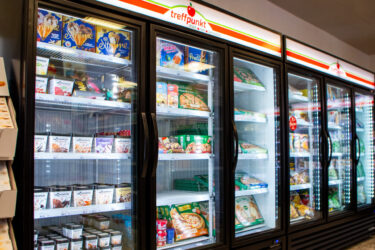
For retail and convenience operators, display refrigeration needs to combine strong product visibility with consistent temperature performance – even during high-traffic periods when doors are opening frequently and ambient temperatures are elevated.
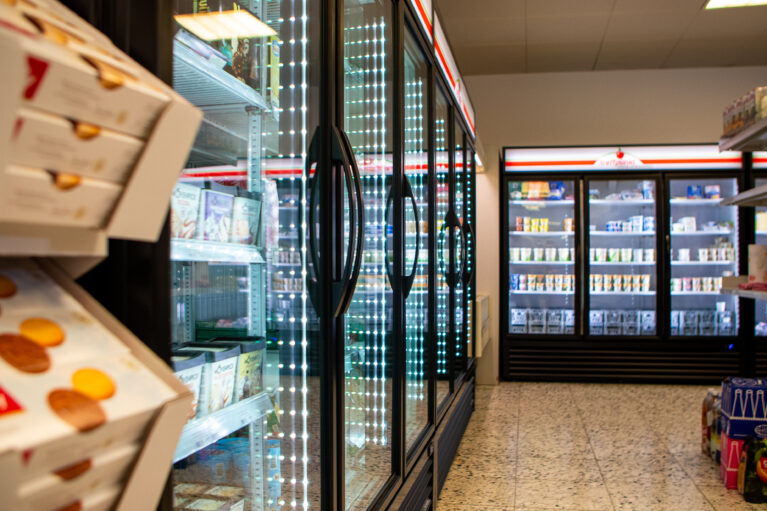
True’s Glass Door Merchandiser (GDM) range, for example, is built to perform in the most demanding environments.
This is because of the fast pull-down times, energy-efficient LED lighting and low-emissivity double-pane thermal insulated glass which helps maintain cabinet temperatures even when external conditions are challenging.
The range also features R290 natural refrigerant, which delivers quicker temperature recovery and fewer breakdowns – qualities that become particularly important during sustained periods of high ambient heat.
For operators looking to maximise product visibility in-store, the True Visual Merchandiser (TVM) range offers high-impact display with reliable temperature consistency – helping products stand out while staying at safe holding temperatures.
Both ranges (which are self-contained, plug-in units) are backed by a 7-year parts and labour warranty across mainland Europe, the UK and Ireland – a commitment to long-term reliability that matters most when conditions are at their most demanding.
The evidence suggests that hotter summers are becoming the norm rather than the exception across Europe. For retail operators, this represents both a challenge and an opportunity.
The capital expenditure required to upgrade ageing refrigeration is significant but the cost of inaction – in spoiled stock, lost trade, compliance risk and reputational damage – is arguably greater.
There is also a sustainability dimension: equipment built for climate resilience and equipment built for energy efficiency are increasingly the same thing.
True’s use of R290 natural refrigerant – with a global warming potential of just 3, compared to more than 1,000 for many older synthetic alternatives – delivers both lower environmental impact and stronger operational performance.
Combined with energy-efficient components and low-emissivity glass, it is an approach that addresses the climate challenge from both sides.
For operators across the retail and convenience sector, refrigeration specification is now a strategic decision, not just an operational one.
Choosing equipment built to perform under sustained pressure – and maintaining it before that pressure arrives – is how operators protect stock, margins and reputation through the seasons ahead.